One Hundred Years On: Einstein’s Japanese Journey Returns to Tokyo
One hundred years ago, on November 17, 1922, the NYK Line’s Kitano Maru entered Kobe port carrying one of history’s most remarkable passengers — Albert Einstein. After more than a month at sea since departing Marseille, Einstein arrived in Japan and stayed for over 40 days, travelling widely across the country.
His impressions were profound. Reflecting on the Seto Inland Sea and the people he encountered, Einstein wrote: “Gentle and refined people and art. The Japanese are more mysterious than I had learned from Lafcadio Hearn’s books, and moreover, considerate and unpretentious.”
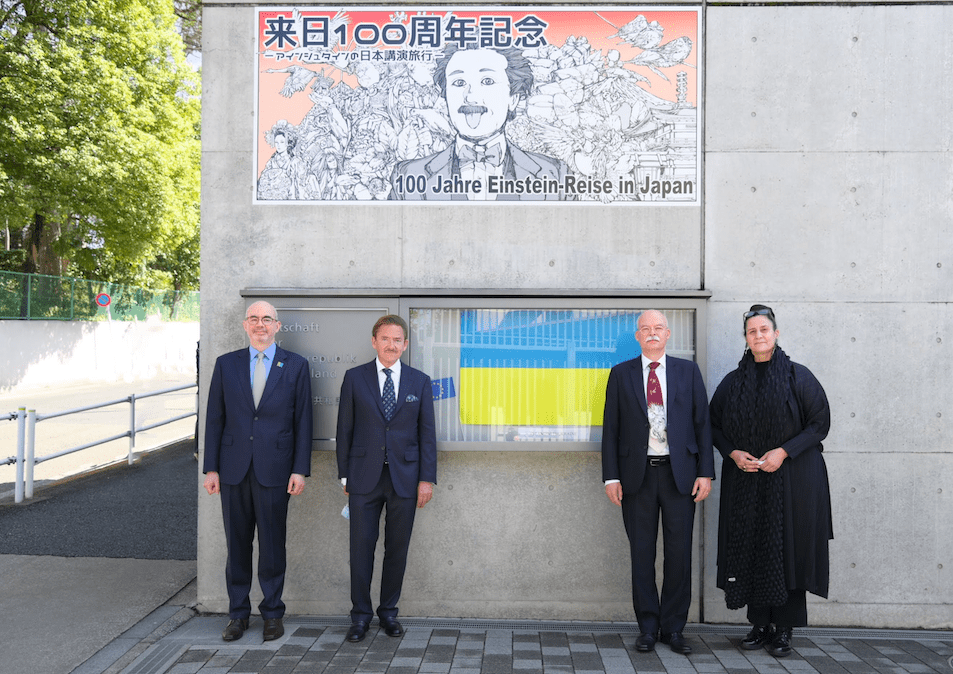
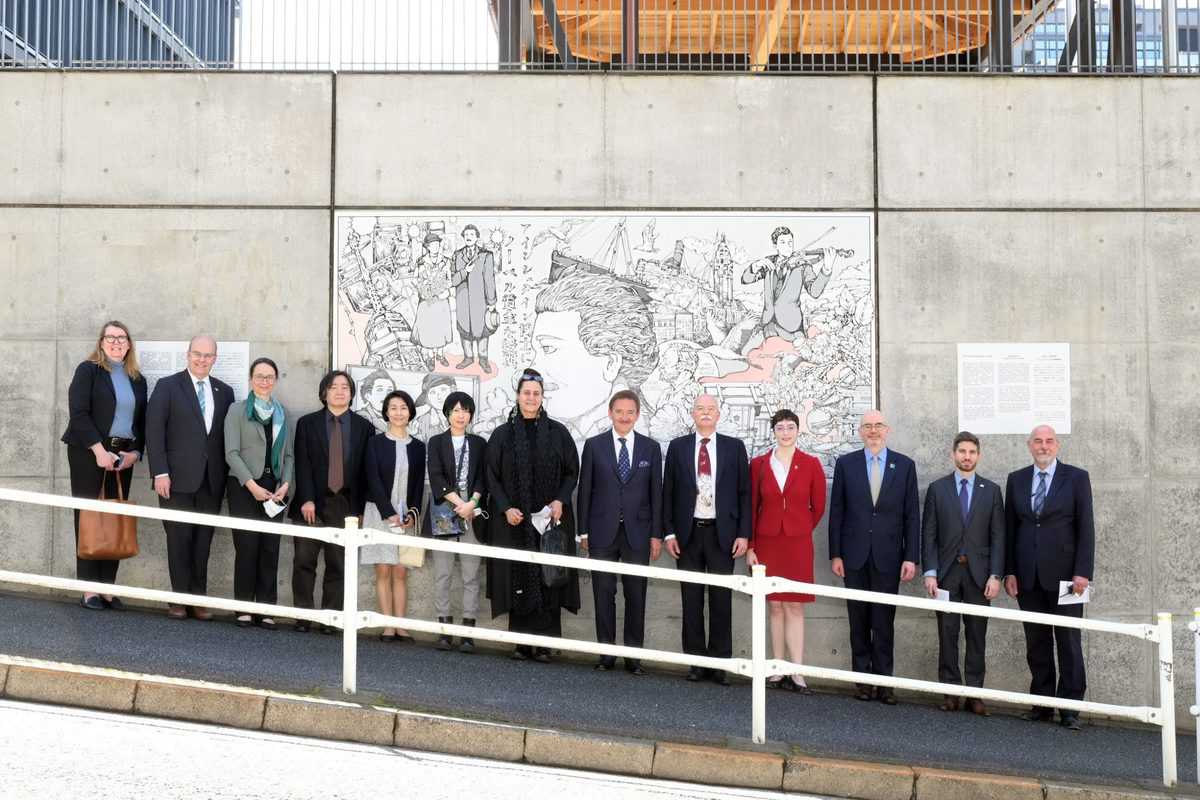
To mark the centenary of that visit, the German Embassy in Tokyo collaborated with manga artist Shinnosuke Uchida to create a striking exterior wall artwork — a cartoon depiction of Einstein walking through a mysterious and enchanting Japan, recreating the atmosphere of his 1922 journey.
The work was officially unveiled on March 14, 2022, Einstein’s birthday, by German Ambassador to Japan Clemens von Goetze. Ambassadors and diplomats from Switzerland, the United States, and Israel — all countries with deep ties to Einstein — gathered to view the mural and celebrate his enduring legacy.
Voices from Countries Connected to Einstein
Clemens von Goetze — German Ambassador to Japan
“Einstein made significant contributions not only to theoretical physics, but also to international understanding and world peace. His visit to Japan in 1922 was his only stay in the country, but his detailed account of the trip reveals how deeply Japanese society and culture impressed him.”
Raymond F. Green — Minister Counsellor, U.S. Embassy in Japan
A colossal bronze statue of Einstein stands in Washington D.C., between the Lincoln Memorial and the White House. Erected in 1979 to mark the centenary of his birth, it depicts him holding a paper inscribed with equations summarising three of his most important scientific contributions, a celestial map at his feet.
Green reflected on the monument’s quiet power: situated in a city filled with grand memorials, this one is notably unassuming — a deliberate reflection of Einstein’s own humility. Inscribed on the bench where the statue sits is one of his most celebrated quotes:
“I will live only in countries where, as far as I can choose, there is civil liberty, tolerance, and all citizens are equal before the law.”
Barak Shein — Spokesperson, Israeli Embassy in Japan
Einstein consistently lived by values central to Jewish tradition — social justice, education, and intellectual development. He used his global fame to provide sworn affidavits helping Jews fleeing the Holocaust enter the United States, continuing until authorities brought the practice to a halt. His influence also shaped the founding of the Hebrew University of Jerusalem, and his emphasis on discovery, development, and innovation remains embedded in Israel’s education system and cultural identity today.
Andreas Baum — Swiss Ambassador to Japan
Einstein moved to Switzerland in 1895 to study, earning degrees in physics and mathematics, and acquired Swiss citizenship in 1901. His legendary Annus Mirabilis — 1905 — saw him publish four groundbreaking papers while based in Bern, laying the foundations for the theory of relativity.
One of his students, Japanese theoretical physicist Jun Ishihara, later recalled that Einstein was eager to learn about the Orient from Japanese students, reflecting an intellectual curiosity that extended far beyond science. Einstein, Baum noted, sought to understand diverse people and cultures “without discrimination” — a quality that makes him as relevant today as ever.
The exterior wall artwork is on display at the German Embassy in Tokyo. Further information is available on the Embassy’s official website.